Sunsetting was not part of the Software Preservation Network’s founding conversation. Organizations are built to last — or at least that’s the implicit assumption baked into most strategic plans, member recruitment pitches, and grant applications. But what happens when an organization has done what it set out to do? Or when the ecosystem has shifted in ways that make continuation less meaningful than closure? Or when the honest answer is that the energy, resources, and community trust carried by an organization would do more good somewhere else?
These are the questions that SPN’s Transition Team sat with as it began its sunsetting process in early 2026. And in sitting with them, something became clear: even discussing closure is taboo in the nonprofit sector, leaving little documentation of what it looks like to do it well, i.e., with intention, with values intact, and with an eye toward what the field needs next.
That gap is part of what SPN hopes to address with this resource. This is the account of an organization at the end of its lifecycle, and how we’re embracing this final act and working to preserve everything worth keeping.
The Case for a Sunset Policy
In March 2024, SPN’s Coordinating Committee began developing an Operational Reserve Policy amid broader conversations about budget sustainability. The timing was deliberate: SPN had just onboarded new leadership and was setting goals around a multi-year financial plan, membership growth and retention, and anticipated changes to its fiscal hosting relationship with Educopia.
Most communities of practice have policies governing how they distribute leadership, how they spend money, how they manage conflicts of interest. Very few have policies governing how they close. This is a problem, not because closure is inevitable for every organization, but because the absence of a framework means that when the question arises (and in a sector defined by resource constraints, mission drift, and leadership transitions, it will arise), boards and staff are navigating emotionally charged terrain without guardrails.
A sunset policy doesn’t presuppose failure. It’s a governance document that says: “we have thought carefully about what responsible closure looks like for our organization, and we have documented it in advance so that the decision can be made clearly and carried out with care”.
For SPN, the sunset policy wasn’t something that got written in the middle of a crisis. It was already there. SPN’s Operational Reserve Policy included a clear trigger: if the combination of remaining revenue in a calendar year and unrestricted net assets fell below twelve months of operating expenses, SPN would initiate a structured sunsetting process. When that threshold was reached, the decision didn’t have to be invented from scratch because the framework held. Leadership could move from “should we close?” to “how do we close well?”.
“The purpose of an operating reserve (unrestricted net assets) is to ensure sufficient financial capacity to maintain liquidity, absorb variability in revenue and expenses, and to sustain core operations over time. Operating reserves provide a runway for slow, thoughtful, deliberative decision-making during periods of change by supporting continuity through revenue stabilization and operational adjustments. If financial capacity cannot be restored, operating reserves allow for a structured review of broader options such as a merger, a fiscal host migration, or sunsetting. This is a responsible practice, and these thresholds and their meaning should be defined when the community is in a healthy, calm state.” – Racquel Asante, Co-Executive Director – Finance & People Operations (Educopia)
What Should a Sunset Policy Include?
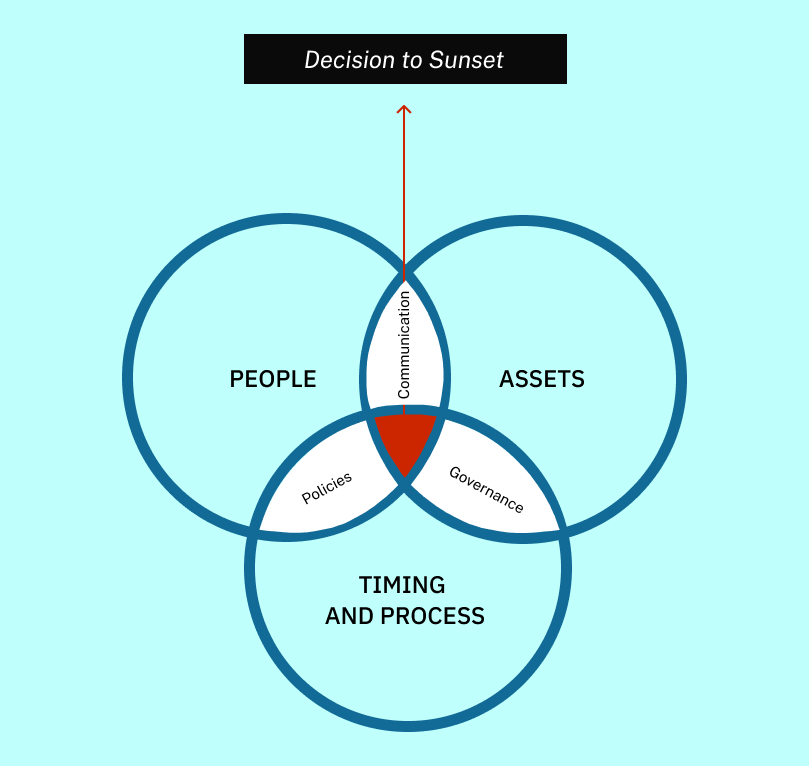
Educopia, SPN’s fiscal sponsor, brings a structured framework to organizational transitions, one that applies whether a community is sunsetting, merging, incorporating, or restructuring. As a backbone organization with deep experience stewarding and supporting knowledge communities through change, Educopia mapped five phases that any organization moving through transition is likely to recognize: Precipitating Conditions, Sensemaking, Designing the Transition, Implementation, and Stewarding What Follows. SPN’s sunsetting process has moved through all five, and future posts in this series will document each in turn. This post focuses on the first two. What were the conditions that made sunsetting the right decision, and how did SPN make decisions about the different dimensions—timing and process, people, assets—surrounding this decision?
For each dimension of that process, we’ve paired SPN’s own reflections and decisions with a short checklist of questions for other organizations to consider. The goal is to make this useful in both directions: as an honest account of how one organization navigated closure, and as a practical starting point for any community that may one day need to do the same.
Defining Sunsetting Conditions
Following our governance structure, SPN’s operational reserve policy was co-developed by our Program Manager, Educopia’s Co-Executive Director (Fiscal Sponsorship), and the Coordinating Committee Treasurer, and then approved by the broader Coordinating Committee. When it became clear we were approaching our twelve-month runway, we consulted our membership on strategies to increase revenue, knowing the sunset would be triggered if alternative approaches didn’t yield results.
Questions for groups and organizations to ask as they are developing a sunsetting policy:
- What specific conditions would trigger a formal sunset conversation? (e.g., reserve threshold, inability to fulfill mission, leadership departure, mission accomplishment)
- Who has the authority to initiate that conversation?
- Who must be present in the decision-making process: leadership, fiscal sponsor, key community stakeholders?
- What documentation needs to be shared with the governing body in order to demonstrate thresholds have been met for the sunset?
- How will affected stakeholders (staff, members, community partners, funders) be engaged in or informed of the decision before it is finalized?
Timing and Process
SPN’s twelve-month runway was shaped by the scope of what needed to happen: archiving years of organizational assets, supporting members in finding or developing new spaces for convening around software preservation, and partnering with allied organizations to continue SPN’s legacy. The Coordinating Committee transitioned into the Sunset Transition Team, with key community stakeholders supporting the archiving and distribution of the organization’s assets
Questions for groups and organizations to ask regarding timing and process for a sunset:
- What is the minimum runway the organization commits to giving itself between a dissolution decision and official closure? (Plan for at least six months; larger or more complex organizations should plan for longer)
- What are the key phases of the wind-down, and who owns each?
- What transition leadership structure will govern the process?
- How will progress be documented and communicated throughout?
People
We began with our internal community first, both as thought-partners in the decision to sunset and as people who needed space to emotionally process it. Member town halls, 1:1s with the Program Manager, and monthly newsletters have kept the community informed and involved, with ongoing opportunities to tap into the work. SPN’sProgram Manager balances time across the Transition Team, working groups, and members to shape the sunsetting process and create opportunities to learn new skills together about what it means to bring a community to a close with care.
- How and when will staff be notified?
- What severance, reference support, or placement assistance will the organization provide?
- How will volunteers, contractors, and working group members be supported in transition?
- How will leadership acknowledge and process the emotional dimensions of closure, both for themselves and for the team?
Assets
A core goal of SPN’s sunset is ensuring that the organization’s outputs are preserved, organized, and made accessible to practitioners in cultural heritage and software preservation long after the Network closes. As we move through the asset inventory, we are navigating real tensions between protecting the privacy of institutions and individuals associated with SPN’s work and making as much of our history and culture accessible as possible. With a substantial archive and only a year to work through it, we are learning to prioritize: assets that show what SPN was and support practitioners in their workflows, alongside developing clear policy for retaining and accessing sensitive information.
- What principles will guide distribution of remaining financial assets?
- How will programmatic assets (tools, curricula, documentation, archives, frameworks) be assessed and transferred?
- How will digital infrastructure (websites, platforms, software deployments) be wound down or transferred responsibly?
- What does the organization owe its community in terms of continued access to institutional knowledge?
- Who in the field is best positioned to steward specific assets or programs?
Operationalizing the Policy: Who Needs to Be in the Room?
A sunset policy is only as good as the process it enables. Operationalizing it well requires deliberate attention to who is involved and when. Here are a few of our emergent learnings:
Leadership — including staff leadership and coordinating committee or governance structures — needs to be present from the beginning, not just as decision-makers but as strategic partners and emotional anchors for the process. For SPN, this meant early, ongoing engagement across the Coordinating Committee and staff, with the understanding that some legal and reporting responsibilities would require sufficient time and oversight to be built in to our process.
A Transition Team brings dedicated focus to the operational work of winding down. This is distinct from day-to-day leadership — it’s a cross-functional group, ideally including a mix of staff, governance, and community representatives, whose job is to steward the process end-to-end. SPN developed a Sunset Transition Team to advance the core objectives of the closure: legacy preservation, responsible member support, asset redistribution, transparent process documentation, and sustained field-building impact. Having a named team with a defined mandate meant the work of closing didn’t fall to one person, and it created space for people with different expertise and relationships to contribute.
Community members and constituents should have a voice, even if not a vote. For SPN, this has looked like town halls, 1:1 check-ins with members, and participation from a community-led transition team. These touchpoints shaped the decisions being made, including how to approach the asset map and where to prioritize field-facing resources.
Outside advisors: an attorney familiar with nonprofit dissolution, a finance consultant, and potentially a strategy or communications consultant — folks with specializations like these provide essential expertise and external perspective. Some of these skillsets may already live in your governance structure, but having someone whose primary role is to support the process can be genuinely useful.
Field partners and aligned organizations are central in this process for an organization like SPN (one whose explicit purpose was to centralize and support a broader ecosystem). Understanding where the work is going, who can carry it forward, and what resources need to flow where isn’t just logistically important, it’s a value statement.
What the Field Can Learn from This
SPN’s sunset is, among other things, an argument that closure can be a form of contribution. That an organization which has centralized knowledge, built community, and catalyzed practice in software preservation can give one final, significant gift to the ecosystem: a model for how to leave well.
The policy framework and the composting1 orientation are not separate ideas. The policy creates the conditions — the clarity, the structure, the shared accountability — that make values-aligned wind downs possible. And the values orientation is what transforms a policy from a compliance document into an act of care.
As SPN’s Program Manager Chelle Sanders reflects: “It is my belief that, sometimes, organizations have to take a step back in order to create more possibilities and opportunities for their field of work. As we continue into 2026, I hope we’ll be able to enjoy the process of reflecting on the role SPN has played and provide guidance to future volunteers about how organizing around this work can be strengthened for future networks.”
The sunsetting process is SPN’s attempt to make that step back as generative as possible, both for the people who built this network, and for the field that will continue the work.
This document is the first in a series of field-facing reflections produced by the Software Preservation Network as part of its sunsetting process. To stay informed, reach out to SPN’s Program Manager Chelle Sanders: chelle.sanders@softwarepreservationnetwork.org